The competition challenge solved is the birds/aircraft binary classification.
Due dataset consists of:
Each image are represented by 1D array of length 3072.
The score metric used is ROC AUC.
Since the dataset is big enough, the neural network aproach was chosen.
The layers used for feature extracion are due VGG-16 layers. Ones are listed below:
| Layer (type) | Output Shape | Param # |
|---|---|---|
| input_layer (InputLayer) | (None, 32, 32, 3) | 0 |
| block1_conv1 (Conv2D) | (None, 32, 32, 64) | 1,792 |
| block1_conv2 (Conv2D) | (None, 32, 32, 64) | 36,928 |
| block1_pool (MaxPooling2D) | (None, 16, 16, 64) | 0 |
| block2_conv1 (Conv2D) | (None, 16, 16, 128) | 73,856 |
| block2_conv2 (Conv2D) | (None, 16, 16, 128) | 147,584 |
| block2_pool (MaxPooling2D) | (None, 8, 8, 128) | 0 |
| block3_conv1 (Conv2D) | (None, 8, 8, 256) | 295,168 |
| block3_conv2 (Conv2D) | (None, 8, 8, 256) | 590,080 |
| block3_conv3 (Conv2D) | (None, 8, 8, 256) | 590,080 |
| block3_pool (MaxPooling2D) | (None, 4, 4, 256) | 0 |
| block4_conv1 (Conv2D) | (None, 4, 4, 512) | 1,180,160 |
| block4_conv2 (Conv2D) | (None, 4, 4, 512) | 2,359,808 |
| block4_conv3 (Conv2D) | (None, 4, 4, 512) | 2,359,808 |
| block4_pool (MaxPooling2D) | (None, 2, 2, 512) | 0 |
| block5_conv1 (Conv2D) | (None, 2, 2, 512) | 2,359,808 |
| block5_conv2 (Conv2D) | (None, 2, 2, 512) | 2,359,808 |
| block5_conv3 (Conv2D) | (None, 2, 2, 512) | 2,359,808 |
| block5_pool (MaxPooling2D) | (None, 1, 1, 512) | 0 |
The classifier layers, in turn, consists of folowing ones:
- Flatten (for convolutional->fully-connected transition);
- Dense with 512 neurons using ReLU activation function;
- Dropout with 0.8 rate (for preventing overfitting);
- 1 neuron Dense using sigmoid activation function (for binary prediction: 0/1).
Therefore, the final network architecture is:
| Layer (type) | Output Shape | Param # |
|---|---|---|
| vgg16 (Functional) | (None, 1, 1, 512) | 14,714,688 |
| flatten (Flatten) | (None, 512) | 0 |
| dense (Dense) | (None, 512) | 262,656 |
| dropout (Dropout) | (None, 512) | 0 |
| dense_1 (Dense) | (None, 1) | 513 |
The input given is 1D array of length 3072. We've made the assumption, that initially images have 32x32 size and 3 color channels. So we reshape arrays to 32x32x3 prior to using ones.
While training all classifier layers, we use Transfer Learning and Fine-tunning for convolutional ones i.e. VGG-16 block4 is re-trained as well as block5, but input layer and blocks1-3 weights remain the same.
During compilation Adam optimizer with learning rate 1e-5 is used while the loss function is binary crossentropy and the only metric is accuracy.
12% of training dataset are used for validation.
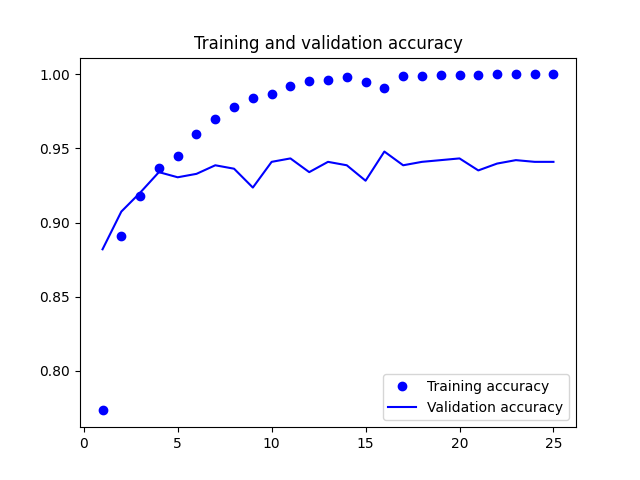
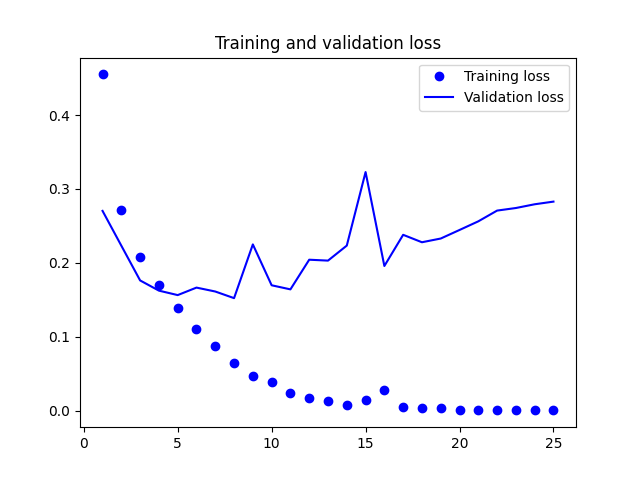
We believe that the training statistic graphs above shows that there is the overfiting starting on 12th epoch, so we use 11 ones.
The training is fast: each epoch takes only ~30 seconds on CPU (11th Gen Intel(R) Core(TM) i7-11850H @ 2.50GHz with AVX2 AVX512F AVX512_VNNI FMA instructions)
The prediction obtained using the model described above got score 0.88916 and public score 0.89340, making it the top 1 competition result.
Thus, out VGG-16 Top-tuning together with custom classifier layers have good accuracy while it is lightweight in terms of computations and does not require strong ML skills to develop.

-
Create and activate a Python virtual environment:
python3 -m venv venv source venv/bin/activate -
Install required dependencies:
pip install -r requirements.txt
-
Run the classification script:
python3 script.py
- Nikita Shchutskii: GitHub, Telegram
- Maxim Rodionov: GitHub, Telegram
- Dmitri Chirkov: GitHub, Telegram
- Vladimir Zaikin: GitHub, Telegram
Distributed under the MIT License. See LICENSE for more information.