
UNIVERSITY OF WEST ATTICA
SCHOOL OF ENGINEERING
DEPARTMENT OF COMPUTER ENGINEERING AND INFORMATICS
University of West Attica · Department of Computer Engineering and Informatics
Data Structures
Vasileios Evangelos Athanasiou
Student ID: 19390005
Supervision
Supervisor: Georgios Bardis, Assistant Professor
Co-supervisor: Georgios Meletiou, Laboratory Teaching Staff
Co-supervisor: Georgios Tselikis, Postdoctoral Researcher
Athens, December 2022
This project implements a Stack Data Structure in C using dynamic memory allocation.
It provides standard stack operations along with additional utilities for transferring and copying data between multiple stacks.
| Section | Folder/File | Description |
|---|---|---|
| 1 | INSTALL.md |
Installation and compilation instructions |
| 2 | README.md |
Project overview and usage guide |
| 3 | assign/ |
Assignment description images |
| 3.1 | assign/Stacks.png |
Stacks assignment image (English) |
| 3.2 | assign/Στοίβες.png |
Stacks assignment image (Greek) |
| 4 | src/ |
Source code of the stacks implementation |
| 4.1 | src/main.c |
Program entry point and stack usage example |
| 4.2 | src/stacks.h |
Stack data structure declarations and function prototypes |
| 4.3 | src/stacks.c |
Implementation of stack operations |
Stacks are created with a user-defined capacity and allocated on the heap.
Includes protection mechanisms to prevent runtime errors:
isFull- prevents stack overflowisEmpty- prevents stack underflow
Transfers all elements from Stack 1 to Stack 2, reversing their order.
Creates an exact copy of a stack while preserving the original element order.
A printStack function displays stack contents without permanently removing elements.
init(stack *s, int capacity)
Allocates memory for a stack with the specified capacity.
push(stack *s, int value)
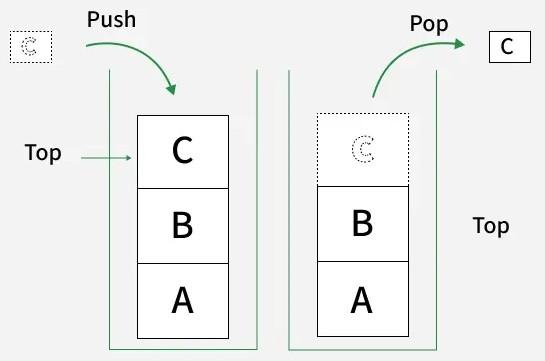
Adds an integer value to the top of the stack.
pop(stack *s, int *value)
Removes the top element from the stack and stores it through a pointer.
destroy(stack *s)
Releases dynamically allocated memory to prevent memory leaks.
Transfer (transfer)
- Pops elements from Stack 1
- Pushes them into Stack 2
- Result: the order of elements becomes reversed
Copy (copyStack)
- Uses a temporary stack
- Copies Stack 1 into Stack 2
- Preserves the original order in both stacks