A different tool (software, language, or package) for each day.
12 days, 12 options, pick wisely.
- Pick a new pick each day, and once picked, it cannot be used again.
- Once a pick is locked in, it cannot be changed anymore, even if part 2 doesn't suit the pick.
- No AI autocomplete allowed, with the exception of generating markup.
- Maximize learning and fun, speed is not relevant.
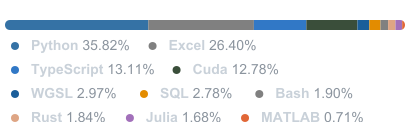
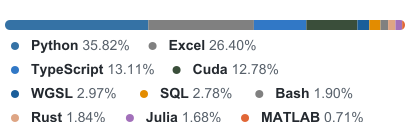
| Day | Tool | Rationale/Experience | Rating | Minutes |
|---|---|---|---|---|
| 1 | Excel | Good problem to tick off Excel, reused most of part 1 for part 2. | Easy | 13/15 |
| 2 | Bash | Used Termux on android, part 1 was straightforward, got stuck a bit on part 2, mainly because long processing time complicated it. | Easy | 19/54 |
| 3 | SQL | Should have been easy, and part 1 was ok, but didn't translate at all to part 2, so wasted a lot of time, even tried batching adapted part 1 script before using subqueries. | Medium | 33/96 |
| 4 | MATLAB | Besides the weird syntax and not so great documentation this was very straightforward. | Easy | 32/52 |
| 5 | Julia | Fun fact! Arrays start at 1 in Julia, part 1 took a bit longer because reading is hard and I was calculating the spoiled IDs instead, reused part 1 for part 2. | Easy | 41/52 |
| 6 | WebGPU | That was challenging (but fun!), ran into issues for part two because I used a float32 so the calculation was actually correct, but the result not. Very happy with the end result, spent way too much time on styling. | Medium | 134/208 |
| 7 | Rust | I may have been less rusty (or more) than I thought, initially wanted to go with a hashmap, but instead went with a simple set/vector solution for both 1 & 2. | Medium | 25/38 |
| 8 | NetworkX | Happy with my NetworkX pick, used union-find(Kruskal's) for both part 1 & 2, stop at 1000 edges for 1 and when connected for 2. | Easy | 12/19 |
| 9 | OR-Tools | Part 1 was ok, would have been a lot easier with itertools instead of ortools. Feeding the solver the right constraints for part 2 was a challenge. Used the CP-SAT Solver and the documentation was very helpful. | Hard | 39/68 |
| 10 | CUDA | Of course the perfect solver problem came the day after shoehorning my solver pick. Brute-forced part 1, GPU didn't even sweat, the challenge was reading comprehension. Part 2 was not brute-forceable so I tried different ways of reducing the search space before feeding it to the GPU, tried DFS, getting close with a genetic algo on CUDA before bruteforcing the space around the results from the algo, but in the end a pure GPU solution with a matrix row reduction step in the kernel worked. | Extreme | 135/>6h |
| 11 | Marimo | Played around with Altair, was hoping for a bit more interactivity opportunities in part 2. | Easy | 37/54 |
| 12 | OpenVINO | Used convolutions to detect valid piece placements, treating shapes as kernels and the board as a tensor, effectively abusing computer vision for a constraint satisfaction problem. Had to really reframe the problem to fit OpenVINO in the solution. | Hard | 110 |
Why did I pick these tools?
-
Bash: used Bash a lot over the last years and want to try some parsing with it.
-
CUDA(Python): new for me, brute-forced day 11 last year (blinking intensifies) using CuPy and actually had a lot of fun, want to try and write my own kernel for a problem that is better fitting this time around.
-
Excel: used to use Excel a lot until 7-8 years ago, will use pure formulas, no macros.
-
Julia: also new for me, but heard a lot of great things about it.
-
Marimo(Python): definitely a flex pick, replaced all my EDA notebooks and light UI with Marimo, goal is to use the interactive nature of Marimo for a problem that is suited for it (like day 8 '22).
-
MATLAB: used this 15 years ago for the last time, liked it then.
-
NetworkX(Python): went deep into networkx last year and really enjoyed getting back into graph algorithms.
-
OpenVINO(Python): want to do one edge-inference style solution with an old Intel Neural Compute Stick 2, will probably regret this pick.
-
OR-Tools(Python): it's often not ideal, but I want to solve using solvers at least once.
-
Rust: have been learning Rust for the last year and a half, still struggling a bit though.
-
SQL: SQL can JOIN this year too.
-
WebGPU(TypeScript): another new one, want to manage the puzzle state from the browser and offload heavy lifting to the GPU. Decided on Typescript instead of wgpu-py because I want to have a browser run demo/visualization.
(contains spoilers!)

Not so elegant but simple formula for part 2.

Sub 200 ms for part 2 (was taking over 30 minutes with the adapted part 1 query).


Fully in Advent of Code styling!

Obligatory 3D plot of part 1.

I know the OR-Tools pick is not ideal, but sometimes you have to find a problem for your solution instead of a solution for your problem. (aged like milk)

GPU goes BRRRRR


Convolutions, not just for detecting cats anymore.

While creating the visuals for day 12, I noticed there are no edge cases where it takes a lot of backtracking to find a fit, it either fits in the first run, or stays stuck around 81% fill and keeps backtracking. This plot shows that the last day may have been the easiest for people that started with some EDA. But I think the puzzle would have been better with a distribution around the edge cases.
If you want to try your solution on a better distributed dataset, you can check out my betterinput script, this will generate a much harder version of the input that will not work for the lazysolution.
How to run the solutions yourself
- Python 3.13+
- uv for dependency management
- CUDA 12.x (for Day 10 only)
git clone https://github.com/stevenbtw/aoc_2025.git
cd aoc_2025
uv sync# Day 3
uv run day03/setup_db.py
uv run day03/write_input_to_sql.py
# Then run the part1.sql and part2.sql on the duck.db instance
# Day 8
uv run day08/solution.py
# Day 9
uv run day09/solution.py
# Day 10
uv run day10/part1.py
uv run day10/part2.py
# Day 11
uv run marimo edit day11/notebook.py
# Day 12
uv run day12/create_model.py
uv run day12/run_inference.py input.txt
| Day | How to run |
|---|---|
| 1 | Open day01/solution.xlsx in Excel |
| 2 | bash day02/part1.sh |
bash day02/part2.sh |
|
| 4 | Open day04/solution.m in MATLAB |
| 5 | julia day05/solution.jl |
| 6 | See day06/README.md (requires Node.js + WebGPU browser) |
| 7 | cargo run in day07/ |
Here are some of my takeaways after almost 20 hours and 23 solutions:
What worked: The forced Bingo Card challenge meant I actually touched things I'd been meaning to pick up (again) for years. The "no changing picks for Part Two" rule created a really intense learning experience. Day 10 with CUDA would have been much easier with something else, but pushing through taught me more than changing would have. Trying weird solutions while listening to a notebooklm podcast of the cuda programming guide will be one of the nice memories of Advent of Code this year. Having only 12 days for this year's challenge was actually good, 25 days was pretty long last time even with using the go-to python solutions, I am ok with not doing this challenge for another 13 days.
Things that made it hard: Troubleshooting the precision error with WebGPU, the matrix row reduction approach for Day 10, and rethinking OpenVINO convolutions for constraint satisfaction. All of these brought back real problem solving fun, out-of-the-box thinking and not just identifying the correct python package.
Things that made it easy: Using the correct picks for the first days helped. And the graph puzzles didn't really offer any challenge this year. I also copied the CUDA, WebGPU, and OpenVINO code straight from the documentation and just hacked my logic into it. Some solutions probably look more polished than my actual knowledge of these tools. I also wanted to avoid using generative AI during the challenge and mostly succeeded. It was refreshing, to turn everything off and write code fully by hand. The only exception was HTML for some visualizations on days 6 and 9, where I used autocomplete to generate the markup. I also used ChatGPT and NotebookLM as learning tools to understand new and old concepts. For the last day I used the CPU and didn't use my Neural Compute Stick 2, support ended a long time ago and I didn't feel like package management hell which also made the challenge a bit easier to be fair.
For next time: Probably only Python & Rust, and try different techniques/packages, maybe use Marimo notebooks starting with some EDA each day, check the lazy solution why this can be helpful.