
EXFOLIATE! EXFOLIATE!




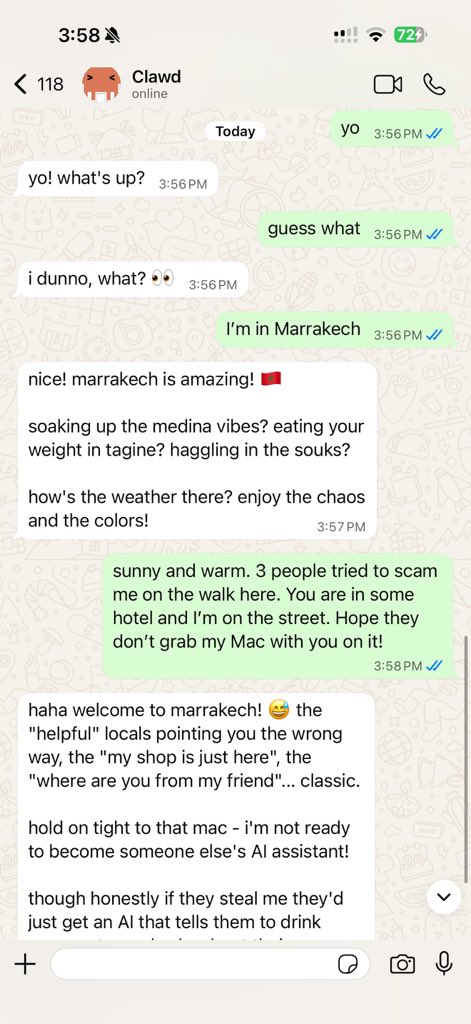
Clawdbot is a personal AI assistant you run on your own devices. It answers you on the surfaces you already use (WhatsApp, Telegram, Slack, Discord, Signal, iMessage, WebChat), can speak and listen on macOS/iOS/Android, and can render a live Canvas you control. The Gateway is just the control plane — the product is the assistant.
If you want a personal, single-user assistant that feels local, fast, and always-on, this is it.
Website: https://clawdbot.com · Docs: https://docs.clawdbot.com · Showcase: https://docs.clawdbot.com/showcase · FAQ: https://docs.clawdbot.com/faq · Wizard: https://docs.clawdbot.com/wizard · Nix: https://github.com/clawdbot/nix-clawdbot · Docker: https://docs.clawdbot.com/docker · Discord: https://discord.gg/clawd
Preferred setup: run the onboarding wizard (clawdbot onboard). It walks through gateway, workspace, providers, and skills. The CLI wizard is the recommended path and works on macOS, Windows, and Linux.
Works with npm, pnpm, or bun.
Subscriptions (OAuth):
- Anthropic (Claude Pro/Max)
- OpenAI (ChatGPT/Codex)
Model note: while any model is supported, I strongly recommend Anthropic Pro/Max (100/200) + Opus 4.5 for long‑context strength and better prompt‑injection resistance. See Onboarding.
Do not download prebuilt binaries. Build from source.
# Clone this repo
git clone https://github.com/clawdbot/clawdbot.git
cd clawdbot

pnpm install
pnpm build
pnpm ui:build
pnpm clawdbot onboardRuntime: Node ≥22.
From source, pnpm is the default workflow. Bun is supported as an optional local workflow; see docs/bun.md.
# Install deps (no Bun lockfile)
bun install --no-save

# Build TypeScript
bun run build

# Build Control UI
bun install --cwd ui --no-save
bun run --cwd ui build

# Recommended: run the onboarding wizard
bun run clawdbot onboard

# Link WhatsApp (stores creds in ~/.clawdbot/credentials)
bun run clawdbot login

# Start the gateway
bun run clawdbot gateway --port 18789 --verbose

# Dev loop (auto-reload on TS changes)
bun run gateway:watch

# Send a message
bun run clawdbot send --to +1234567890 --message "Hello from Clawdbot"

# Talk to the assistant (optionally deliver back to WhatsApp/Telegram/Slack/Discord)
bun run clawdbot agent --message "Ship checklist" --thinking high
Upgrading? clawdbot doctor.
If you run from source, prefer bun run clawdbot … or pnpm clawdbot … (not global clawdbot).
- Local-first Gateway — single control plane for sessions, providers, tools, and events.
- Multi-surface inbox — WhatsApp, Telegram, Slack, Discord, Signal, iMessage, WebChat, macOS, iOS/Android.
- Voice Wake + Talk Mode — always-on speech for macOS/iOS/Android with ElevenLabs.
- Live Canvas — agent-driven visual workspace with A2UI.
- First-class tools — browser, canvas, nodes, cron, sessions, and Discord/Slack actions.
- Companion apps — macOS menu bar app + iOS/Android nodes.
- Onboarding + skills — wizard-driven setup with bundled/managed/workspace skills.
- Gateway WS control plane with sessions, presence, config, cron, webhooks, Control UI, and Canvas host.
- CLI surface: gateway, agent, send, wizard, and doctor.
- Pi agent runtime in RPC mode with tool streaming and block streaming.
- Session model:
mainfor direct chats, group isolation, activation modes, queue modes, reply-back. Group rules: Groups. - Media pipeline: images/audio/video, transcription hooks, size caps, temp file lifecycle. Audio details: Audio.
- Providers: WhatsApp (Baileys), Telegram (grammY), Slack (Bolt), Discord (discord.js), Signal (signal-cli), iMessage (imsg), WebChat.
- Group routing: mention gating, reply tags, per-surface chunking and routing. Surface rules: Surface routing.
- macOS app: menu bar control plane, Voice Wake/PTT, Talk Mode overlay, WebChat, debug tools, remote gateway control.
- iOS node: Canvas, Voice Wake, Talk Mode, camera, screen recording, Bonjour pairing.
- Android node: Canvas, Talk Mode, camera, screen recording, optional SMS.
- macOS node mode: system.run/notify + canvas/camera exposure.
- Browser control: dedicated clawd Chrome/Chromium, snapshots, actions, uploads, profiles.
- Canvas: A2UI push/reset, eval, snapshot.
- Nodes: camera snap/clip, screen record, location.get, notifications.
- Cron + wakeups; webhooks; Gmail Pub/Sub.
- Skills platform: bundled, managed, and workspace skills with install gating + UI.
- Control UI + WebChat served directly from the Gateway.
- Tailscale Serve/Funnel or SSH tunnels with token/password auth.
- Nix mode for declarative config; Docker-based installs.
- Doctor migrations, logging.
WhatsApp / Telegram / Slack / Discord / Signal / iMessage / WebChat
               │
               ▼
┌───────────────────────────────┐
│            Gateway            │  ws://127.0.0.1:18789
│       (control plane)         │  bridge: tcp://0.0.0.0:18790
└──────────────┬────────────────┘
               │
               ├─ Pi agent (RPC)
               ├─ CLI (clawdbot …)
               ├─ WebChat UI
               ├─ macOS app
               └─ iOS/Android nodes
- Gateway WebSocket network — single WS control plane for clients, tools, and events (plus ops: Gateway runbook).
- Tailscale exposure — Serve/Funnel for the Gateway dashboard + WS (remote access: Remote).
- Browser control — clawd‑managed Chrome/Chromium with CDP control.
- Canvas + A2UI — agent‑driven visual workspace (A2UI host: Canvas/A2UI).
- Voice Wake + Talk Mode — always‑on speech and continuous conversation.
- Nodes — Canvas, camera snap/clip, screen record,
location.get, notifications, plus macOS‑onlysystem.run/system.notify.
Clawdbot can auto-configure Tailscale Serve (tailnet-only) or Funnel (public) while the Gateway stays bound to loopback. Configure gateway.tailscale.mode:
off: no Tailscale automation (default).serve: tailnet-only HTTPS viatailscale serve(uses Tailscale identity headers by default).funnel: public HTTPS viatailscale funnel(requires shared password auth).
Notes:
gateway.bindmust stayloopbackwhen Serve/Funnel is enabled (Clawdbot enforces this).- Serve can be forced to require a password by setting
gateway.auth.mode: "password"orgateway.auth.allowTailscale: false. - Funnel refuses to start unless
gateway.auth.mode: "password"is set. - Optional:
gateway.tailscale.resetOnExitto undo Serve/Funnel on shutdown.
Details: Tailscale guide · Web surfaces
It’s perfectly fine to run the Gateway on a small Linux instance. Clients (macOS app, CLI, WebChat) can connect over Tailscale Serve/Funnel or SSH tunnels, and you can still pair device nodes (macOS/iOS/Android) to execute device‑local actions when needed.
- Gateway host runs the bash tool and provider connections by default.
- Device nodes run device‑local actions (
system.run, camera, screen recording, notifications) vianode.invoke. In short: bash runs where the Gateway lives; device actions run where the device lives.
Details: Remote access · Nodes · Security
The macOS app can run in node mode and advertises its capabilities + permission map over the Gateway WebSocket (node.list / node.describe). Clients can then execute local actions via node.invoke:
system.runruns a local command and returns stdout/stderr/exit code; setneedsScreenRecording: trueto require screen-recording permission (otherwise you’ll getPERMISSION_MISSING).system.notifyposts a user notification and fails if notifications are denied.canvas.*,camera.*,screen.record, andlocation.getare also routed vianode.invokeand follow TCC permission status.
Elevated bash (host permissions) is separate from macOS TCC:
- Use
/elevated on|offto toggle per‑session elevated access when enabled + allowlisted. - Gateway persists the per‑session toggle via
sessions.patch(WS method) alongsidethinkingLevel,verboseLevel,model,sendPolicy, andgroupActivation.
Details: Nodes · macOS app · Gateway protocol
- Use these to coordinate work across sessions without jumping between chat surfaces.
sessions_list— discover active sessions (agents) and their metadata.sessions_history— fetch transcript logs for a session.sessions_send— message another session; optional reply‑back ping‑pong + announce step (REPLY_SKIP,ANNOUNCE_SKIP).
Details: Session tools
ClawdHub is a minimal skill registry. With ClawdHub enabled, the agent can search for skills automatically and pull in new ones as needed.
Send these in WhatsApp/Telegram/Slack/WebChat (group commands are owner-only):
/status— health + session info (group shows activation mode)/newor/reset— reset the session/compact— compact session context (summary)/think <level>— off|minimal|low|medium|high/verbose on|off/restart— restart the gateway (owner-only in groups)/activation mention|always— group activation toggle (groups only)
The Gateway alone delivers a great experience. All apps are optional and add extra features.
If you plan to build/run companion apps, initialize submodules first:
git submodule update --init --recursive
./scripts/restart-mac.sh- Menu bar control for the Gateway and health.
- Voice Wake + push-to-talk overlay.
- WebChat + debug tools.
- Remote gateway control over SSH.
Note: signed builds required for macOS permissions to stick across rebuilds (see docs/mac/permissions.md).
- Pairs as a node via the Bridge.
- Voice trigger forwarding + Canvas surface.
- Controlled via
clawdbot nodes ….
Runbook: iOS connect.
- Pairs via the same Bridge + pairing flow as iOS.
- Exposes Canvas, Camera, and Screen capture commands.
- Runbook: Android connect.
- Workspace root:
~/clawd(configurable viaagent.workspace). - Injected prompt files:
AGENTS.md,SOUL.md,TOOLS.md. - Skills:
~/clawd/skills/<skill>/SKILL.md.
Minimal ~/.clawdbot/clawdbot.json (model + defaults):
{
  agent: {
    model: "anthropic/claude-opus-4-5"
  }
}
Full configuration reference (all keys + examples).
- Default: tools run on the host for the main session, so the agent has full access when it’s just you.
- Group/channel safety: set
agent.sandbox.mode: "non-main"to run non‑main sessions (groups/channels) inside per‑session Docker sandboxes; bash then runs in Docker for those sessions. - Sandbox defaults: allowlist
bash,process,read,write,edit; denylistbrowser,canvas,nodes,cron,discord,gateway.
Details: Security guide · Docker + sandboxing · Sandbox config
- Link the device:
pnpm clawdbot login(stores creds in~/.clawdbot/credentials). - Allowlist who can talk to the assistant via
whatsapp.allowFrom. - If
whatsapp.groupsis set, it becomes a group allowlist; include"*"to allow all.
- Set
TELEGRAM_BOT_TOKENortelegram.botToken(env wins). - Optional: set
telegram.groups(withtelegram.groups."*".requireMention); when set, it is a group allowlist (include"*"to allow all). Alsotelegram.allowFromortelegram.webhookUrlas needed.
{
  telegram: {
    botToken: "123456:ABCDEF"
  }
}- Set
SLACK_BOT_TOKEN+SLACK_APP_TOKEN(orslack.botToken+slack.appToken).
- Set
DISCORD_BOT_TOKENordiscord.token(env wins). - Optional: set
discord.slashCommand,discord.dm.allowFrom,discord.guilds, ordiscord.mediaMaxMbas needed.
{
  discord: {
    token: "1234abcd"
  }
}- Requires
signal-cliand asignalconfig section.
- macOS only; Messages must be signed in.
- If
imessage.groupsis set, it becomes a group allowlist; include"*"to allow all.
- Uses the Gateway WebSocket; no separate WebChat port/config.
Browser control (optional):
{
  browser: {
    enabled: true,
    controlUrl: "http://127.0.0.1:18791",
    color: "#FF4500"
  }
}Use these when you’re past the onboarding flow and want the deeper reference.
- Start with the docs index for navigation and “what’s where.”
- Read the architecture overview for the gateway + protocol model.
- Use the full configuration reference when you need every key and example.
- Run the Gateway by the book with the operational runbook.
- Learn how the Control UI/Web surfaces work and how to expose them safely.
- Understand remote access over SSH tunnels or tailnets.
- Follow the onboarding wizard flow for a guided setup.
- Wire external triggers via the webhook surface.
- Set up Gmail Pub/Sub triggers.
- Learn the macOS menu bar companion details.
- Platform guides: Windows, Linux, macOS, iOS, Android
- Debug common failures with the troubleshooting guide.
- Review security guidance before exposing anything.
- Skills config
- Default AGENTS
- Templates: AGENTS
- Templates: BOOTSTRAP
- Templates: IDENTITY
- Templates: SOUL
- Templates: TOOLS
- Templates: USER
Gmail Pub/Sub wiring (gcloud + gogcli), hook tokens, and auto-watch behavior are documented here.
Gateway auto-starts the watcher when hooks.enabled=true and hooks.gmail.account is set; clawdbot hooks gmail run is the manual daemon wrapper if you don’t want auto-start.
clawdbot hooks gmail setup --account you@gmail.com
clawdbot hooks gmail runClawdbot was built for Clawd, a space lobster AI assistant. 🦞
by Peter Steinberger and the community.
See CONTRIBUTING.md for guidelines, maintainers, and how to submit PRs.
AI/vibe-coded PRs welcome! 🤖
Thanks to all clawtributors:


