


Minimal tmux popup radar for Codex, Amp, Claude Code, OpenCode, Pi, Gemini CLI, and Auggie.
Ilmari exists for the moment when a tmux workspace has multiple agent panes and you need to answer three questions quickly:
- which pane is still running
- which pane is waiting on you
- which workspace that pane belongs to
It opens as a tmux popup, inspects the panes you already have running, groups them by workspace, shows agent state plus a visible output excerpt, and jumps you straight to the selected pane.
Ilmari is popup-first and observer-only. It does not launch agents, manage workflows, or own your tmux layout. It gives you a fast index over the agent sessions that already exist.
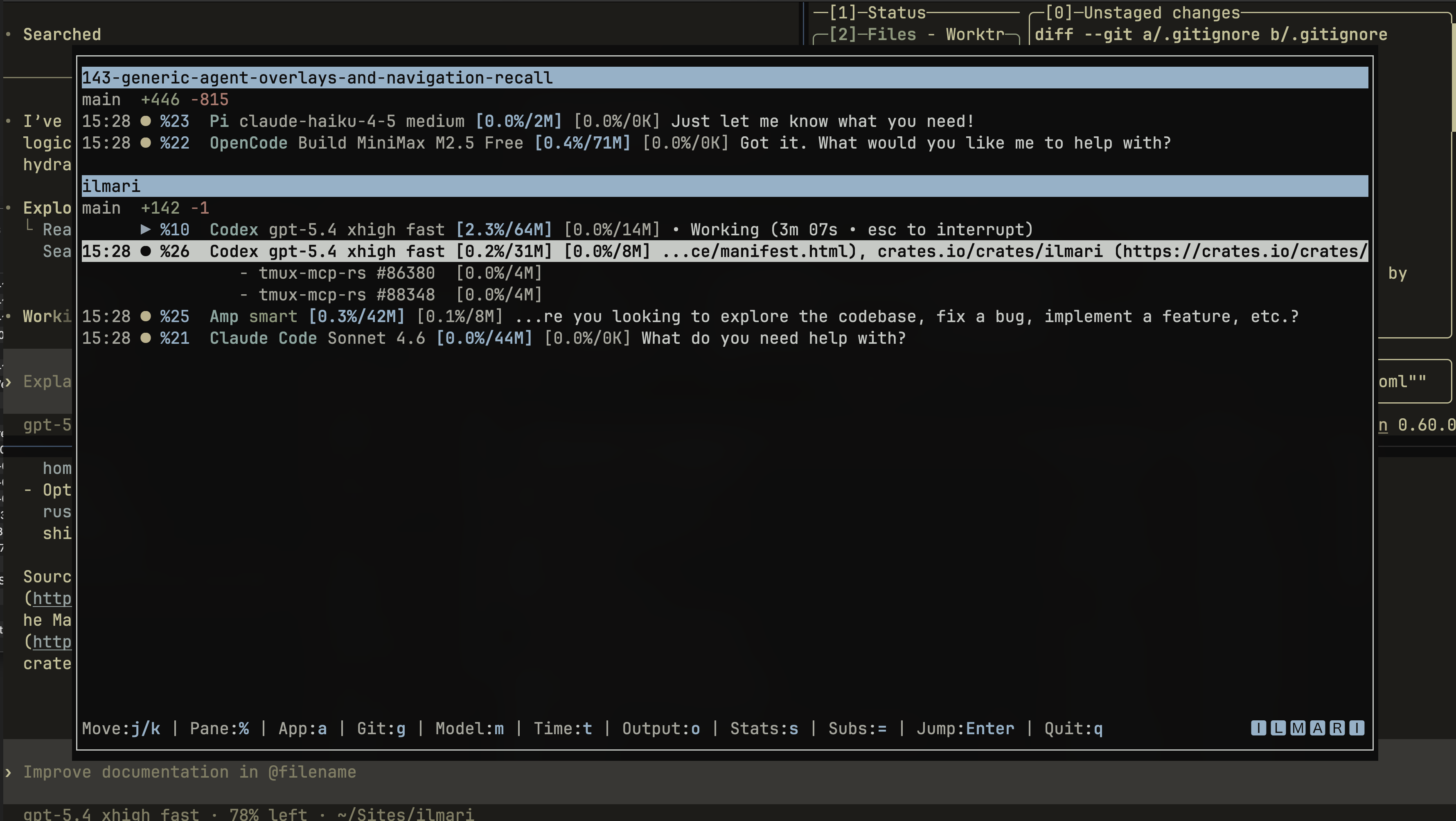
When several agents are running at once, the normal tmux workflow gets noisy:
- waiting panes are easy to miss
- finished panes and still-running panes blur together
- workspaces get split across sessions and windows
- you end up cycling panes manually just to find the one that matters
Ilmari reduces that to a popup:
- detect supported agent panes from tmux metadata and output
- classify panes as running, waiting, finished, terminated, or unknown
- group panes by workspace path
- show lightweight git change context per workspace
- jump to the selected pane and get out of the way
cargo install ilmaribrew install bnomei/ilmari/ilmariDownload a prebuilt archive from the GitHub Releases page, extract it, and
place ilmari on your PATH.
git clone https://github.com/bnomei/ilmari.git
cd ilmari
cargo build --releasetmux popup support requires tmux 3.2 or newer.
Assuming ilmari is already installed and available on your PATH:
bind-key i display-popup -E -w 90% -h 85% "ilmari"Reload tmux after editing ~/.tmux.conf:
tmux source-file ~/.tmux.confPress your tmux prefix, then the bound key.
Typical popup flow:
- open
ilmari - move selection with
j/kor arrow keys - press
Enterto jump to the selected pane
When ilmari is launched as a tmux popup, activation returns you to the target
pane and closes the popup.
Ilmari currently configures through environment variables.
| Variable | Purpose | Default | Notes |
|---|---|---|---|
ILMARI_REFRESH_SECONDS |
Main tmux scan cadence | 5 |
Positive integer seconds. Empty, invalid, or non-positive values fall back to the default. |
ILMARI_PROCESS_REFRESH_SECONDS |
CPU and memory sampling cadence | 15 |
Separate from the main refresh so ilmari does not call ps on every redraw. Empty, invalid, or non-positive values fall back to the default. |
ILMARI_TUI_PALETTE |
Primary palette override | terminal ANSI theme | Takes an 18-slot CSV palette. Takes precedence over ILMARI_PALETTE. |
ILMARI_PALETTE |
Compatibility alias for palette override | terminal ANSI theme | Used only when ILMARI_TUI_PALETTE is unset. |
Examples:
ILMARI_REFRESH_SECONDS=10 ilmari
ILMARI_PROCESS_REFRESH_SECONDS=30 ilmari
Ilmari uses semantic color roles in code, but by default those resolve through
your terminal's current ANSI palette. If you want explicit colors, provide an
18-slot CSV palette override using ILMARI_TUI_PALETTE or ILMARI_PALETTE.
Slot order:
fg,bg,black,red,green,yellow,blue,magenta,cyan,white,bright_black,bright_red,bright_green,bright_yellow,bright_blue,bright_magenta,bright_cyan,bright_white
Accepted color formats:
#RRGGBB0xRRGGBB0XRRGGBBRRGGBBrgb:RR/GG/BBrgb:RRRR/GGGG/BBBB
Behavior:
ILMARI_TUI_PALETTEtakes precedence overILMARI_PALETTE- empty or malformed palette values are ignored
- if neither is set,
ilmariuses the terminal's default ANSI theme

