


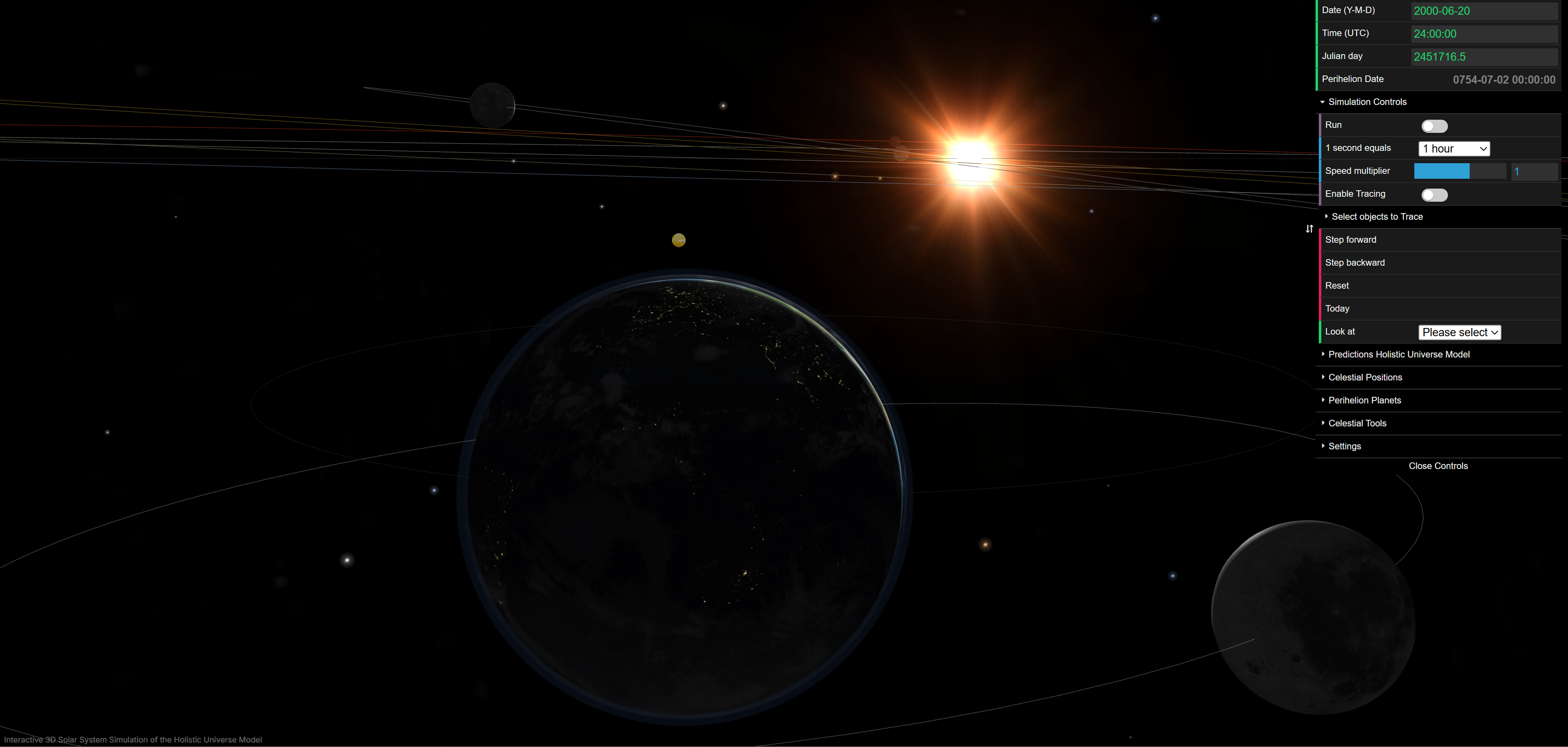
Live Demo — Experience the simulation in your browser
Preprint — Read the accompanying research paper
What if the orbits of all eight planets, the wobble of Earth's axis, and the rhythm of ice ages are all governed by the same mathematical structure?
This interactive 3D simulation visualizes the Fibonacci Laws of Planetary Motion — six laws that connect every planet's orbital tilt, shape, and precession to a single timescale. Built with just 6 free parameters, the simulation accurately reproduces the geocentric positions of the Sun, Moon, and all seven planets — verified against JPL Horizons ephemeris data (~1800–2200 AD) and over 700 historical astronomical observations (~2000 BC to ~4000 AD). From the same geometric framework, it simultaneously produces obliquity, eccentricity, perihelion precession, and inclination oscillation for all planets.
The model starts from a single observation: two of Earth's precession motions rotate in opposite directions.
| Motion | Direction | Cycle |
|---|---|---|
| Axial Precession | Clockwise | ~25,770 years |
| Inclination Precession | Counter-clockwise | ~111,669 years |
These two counter-rotating motions interact in a Fibonacci ratio of 3:13. From this starting point, the model derives what is normally calculated separately: precession of the equinoxes, obliquity oscillation, eccentricity cycles, Milankovitch beat frequencies, the length of days and years, and climate patterns including ice ages.
Everything comes together in the Holistic-Year (H): a 335,008-year megacycle that unifies all precession periods through Fibonacci number ratios (H/3, H/13, H/16) — and this simulation visualizes it all in one interactive view.
The model implements six laws connecting planetary orbital parameters through pure Fibonacci numbers:
- Fibonacci Cycle Hierarchy — One master cycle (H) divided by Fibonacci numbers produces all major precession periods
- The Inclination Constant — Every planet's orbital tilt satisfies a single universal formula using Fibonacci divisors
- The Inclination Balance — Two groups of planets balance to 100%, grounded in conservation of angular momentum
- The Eccentricity Constant — Each planet's eccentricity partition equals a ratio of Fibonacci numbers
- The Eccentricity Balance — The same two planet groups balance independently in eccentricity to 100%
- Saturn-Jupiter-Earth Resonance — A closed beat-frequency loop connects inner and outer solar system dynamics
The Fibonacci divisors follow a mirror symmetry: Mercury↔Uranus, Venus↔Neptune, Earth↔Saturn, Mars↔Jupiter. Out of 755 candidate configurations, only one satisfies all six laws simultaneously.
See the Fibonacci Laws documentation for the full derivation, and Appendix L (88) for comprehensive verification (49/49 checks pass).
The Sun is still the center of our solar system. The model uses a geo-heliocentric frame — viewing from Earth's perspective — to make the two counter-rotating precession motions visible:
- Earth wobbles clockwise around a reference point (the EARTH-WOBBLE-CENTER) in ~25,770 years — this is axial precession
- Earth's perihelion point wobbles counter-clockwise around the Sun in ~111,669 years — this is inclination precession
- These two motions meet every ~20,938 years — producing perihelion precession
- Earth orbits its perihelion point (close to the Sun) in 1 solar year, and all planets orbit their own perihelion points following Kepler's 3rd law
The result: obliquity, eccentricity, inclination, and all precession movements emerge from just two opposing forces in a 3:13 ratio.
For more details see holisticuniverse.com.
- Node.js (v16 or higher)
git clone https://github.com/dvansonsbeek/3d.git
cd 3d
npm install
npm start
The simulation will open in your browser at http://localhost:1234
An interactive data dashboard for exploring planetary orbital elements across a full Holistic Year:
npm run dashboard:export   # generate JSON data from the orbital engine
npm run dashboard          # start dashboard at http://localhost:5050
Features: multi-planet overlay, synchronized zoom/pan, light/dark mode, CSV export, range presets (Full H, H/3, H/5, H/8, H/13, H/16), and obliquity decomposition for Earth.
npm run build- Interactive 3D solar system with textured planets, rings, shadows, and starfield
- Equation of center (variable speed) and empirical parallax corrections for all planets
- Time controls: play, pause, speed adjustment, and date navigation
- Click any planet to focus the camera and see its orbital data
- Planet info sidebar with per-planet data, charts, and precession analysis
- Eccentricity Balance Scale for visualizing Law 5 balance per planet
- Invariable Plane Balance Explorer for interactive Fibonacci Law testing
- Console tests for year length, day length, and calibration verification
- Export functionality for solstice dates and object positions
- Built with Three.js and Tweakpane v4
Detailed documentation is available in the /docs folder, organized by category:
| Range | Category | Start here |
|---|---|---|
| 00–09 | Getting Started & Overview | Introduction, User Guide, Glossary |
| 10–19 | Theory & Model | Fibonacci Laws |
| 20–29 | Technical Reference | Constants Reference, Formulas |
| 30–39 | Calculations | Anomaly, Ascending Nodes, Inclination |
| 40–49 | Architecture & Code | Architecture, Scene Graph |
| 50–59 | UI & Tools | UI Panels, Balance Explorer |
| 60–69 | Optimization Tool | Overview |
| 70–79 | Verification | Ascending Node Limitations |
| 80–99 | Appendices | Code scripts and data spreadsheets |
Investigation & Verification:
- Python Scripts — Statistical significance tests, perihelion precession analysis, exoplanet Fibonacci tests, and predictive formula system
- Master cycle: 335,008 years (the Holistic-Year, H)
- Axial precession: ~25,770 years (H/13)
- Inclination precession: ~111,669 years (H/3)
- Perihelion precession: ~20,938 years (H/16)
- Model parameters: Earth is defined by 26 parameters, the Moon by 9, and each planet by 16 — with only 6 free parameters for the entire model
- Create 100% correct formulas for solstice dates (beyond J. Meeus formula)
- Add more celestial objects
- Three.js — 3D rendering library
- Tychosium — Inspiration
- Solar System Scope — Planet textures
- Yale Bright Star Catalog — Star data
This software is licensed under the GNU General Public License (GPL-3.0). See the LICENSE for details.
For questions about the model or if you want to help develop this further:
- Email: dennis@holisticuniverse.com
- Website: holisticuniverse.com
- GitHub Issues: Report a bug or request a feature