

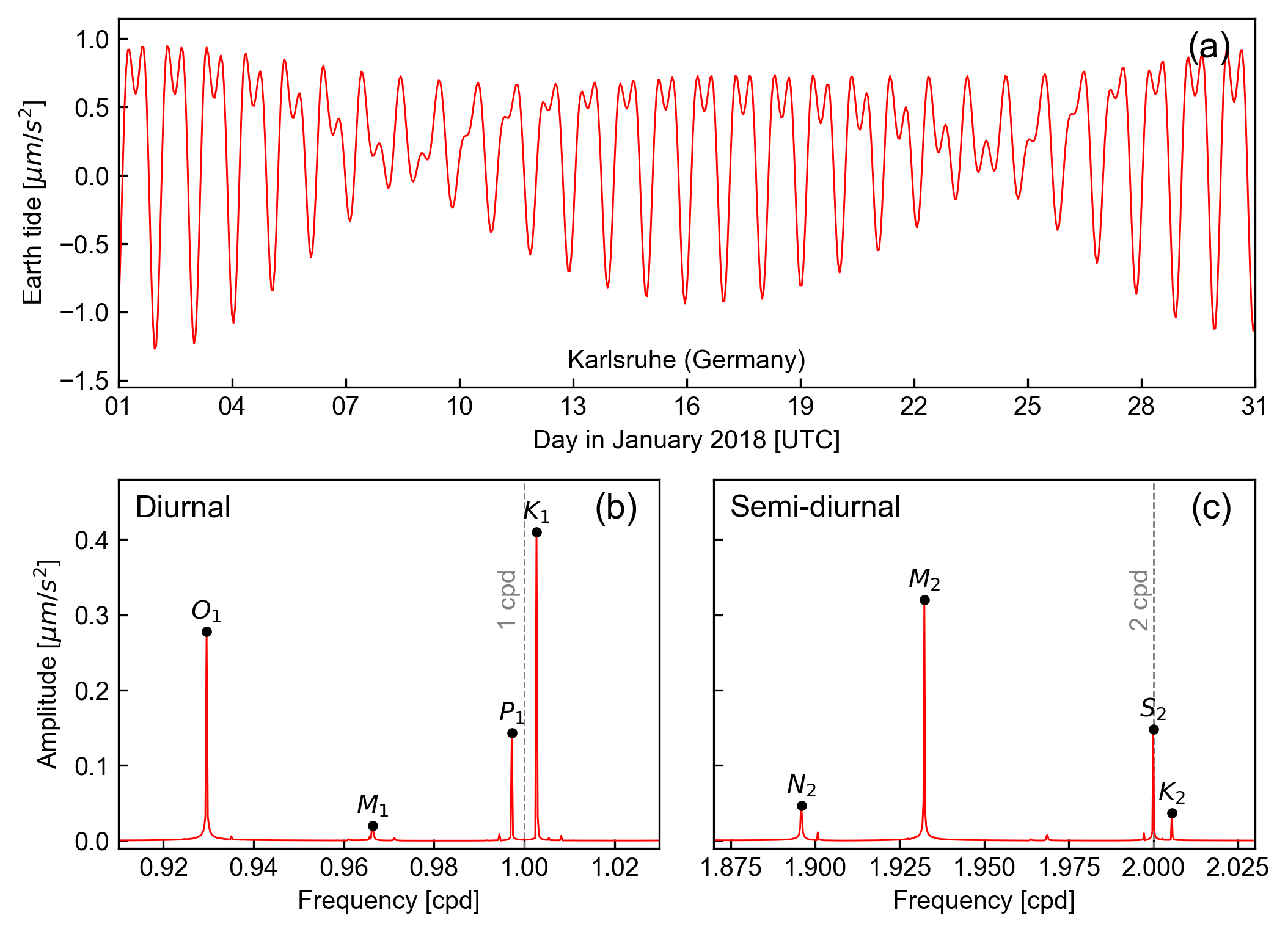
PyGTide is a Python module that wraps around ETERNA PREDICT 3.4 which is compiled from Fortran into an executable using f2py. The original ETERNA PREDICT 3.3 was written by the late Prof. H.-G. Wenzel (Wenzel, 1996) in a mix of Fortran 77 and 90. This was updated by Kudryavtsev (2004) to include the latest tidal catalogue. Note that the original Fortran code was comprehensively revised in order to facilitate integration into Python. The original Fortran code for ETERNA PREDICT can be downloaded from the International Geodynamics and Earth Tide Service (IGETS).
There are two options:
- Download and install on your system (see below instructions)
- Via our online calculator: groundwater.app
Option 1: Install and compile source distribution from PyPi (Python 3.8–3.11) or install pre-compiled distribution (Linux, macOS, Windows; Python>=3.12)
pip install pygtideRequirements for building:
- A Fortran compiler (e.g.,
gfortranvia MinGW on Windows; included in Linux/macOS gcc toolchains)conda install gfortran - Meson build system with ninja: automatically installed via
pip
Clone repo from git:
git clone https://github.com/hydrogeoscience/pygtide.gitInstall from local repository:
cd /path/to/pygtide

pip install .-
Run tests to verify installation:
python -c "import pygtide; pygtide.test(msg=True)" -
Update internal database files (downloads latest leap seconds and pole data):
python -c "import pygtide; pygtide.update()"
See pygtide/tests.py for complete examples. Quick start:
from pygtide import predict_series
args = (-20.82071, -70.15288, 830.0, '2020-01-01', 6, 600)
series = predict_series(*args, statazimut=90, tidalcompo=8)An updated user guide is currently in progress ...
If you use PyGTide, please cite the work as:
Rau, Gabriel C. (2018) hydrogeoscience/pygtide: PyGTid. Zenodo. https://doi.org/10.5281/zenodo.1346260
- Hartmann, T., and H.-G. Wenzel (1995), The HW95 tidal potential catalogue, Geophysical Research Letters, 22(24), 3553–3556, https://doi.org/10.1029/95GL03324.
- Kudryavtsev, S. M. (2004), Improved harmonic development of the Earth tide-generating potential, Journal of Geodesy, 17(12), 829-838, https://doi.org/10.1007/s00190-003-0361-2.
- Wenzel, H.-G. (1996), The nanogal software: Earth tide data processing package ETERNA 3.30, Bulletin d’Informations des Marées Terrestres, 124, 9425–9439.
- McMillan, T. C., and Rau, G. C., and Timms, W. A., and Andersen, M. S. (2019), Utilizing the impact of Earth and atmospheric tides on groundwater systems: A review reveals the future potential, Reviews of Geophysics, https://dx.doi.org/10.1029/2018RG000630.
PyGTide is released by Gabriel C. Rau and Tom Eulenfeld under the Mozilla Public License 2.0