My name is Bill SerGio and I am the inventor of Decision Space™, a new mathematical construct for decision-making. This work introduces a mathematical framework defining a Decision Space™ where candidate actions or states are evaluated, scored, and selected using deterministic cost, energy, and risk functions, without learned weights, probabilities, or historical data.
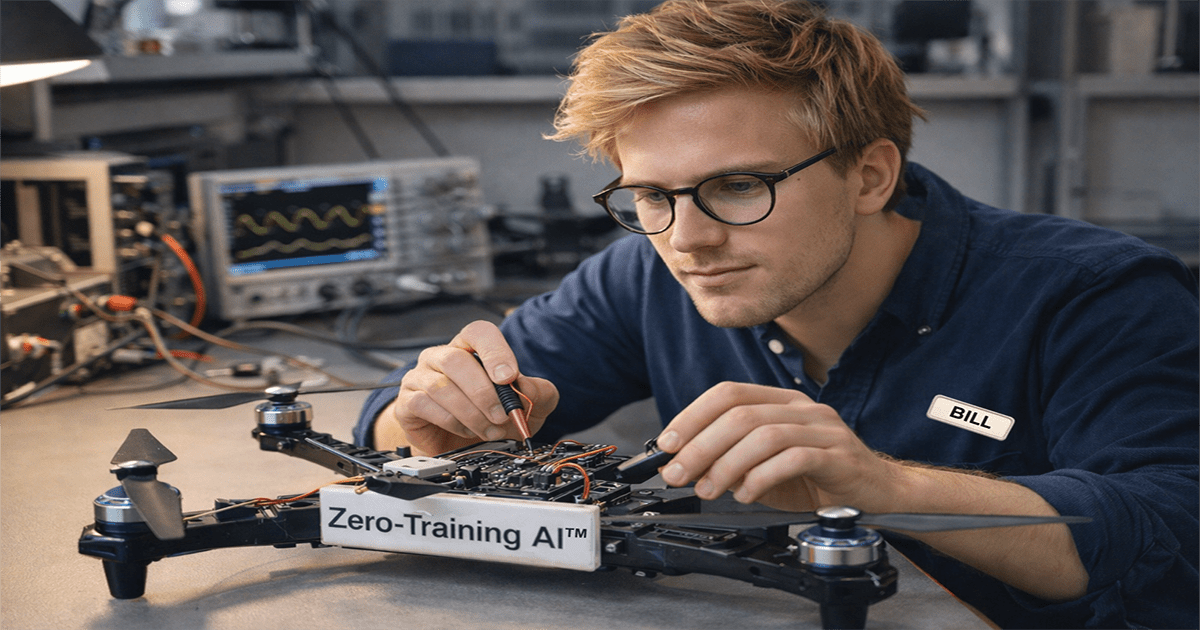


Four deterministic, real-time decision systems that do not use training data, datasets, or machine learning.
Watch Video : https://www.youtube.com/watch?v=7_3RRghur1k
This repository contains a set of interactive web-based demonstrations showcasing Zero-Training AI™ — a class of decision and optimization systems that operate through mathematical evaluation at runtime, rather than statistical learning from data.
At the core of this work is my creation of a new mathematical framework for decision-making, including the formalization of a Decision Space™: a structured space in which candidate actions or states are evaluated, scored, and selected based on deterministic cost, energy, and risk functions.
Decisions emerge from direct evaluation within this Decision Space™, not from learned weights, probabilities, or historical examples.
These demos are intentionally simple, visual, and self-contained, designed to show how certain classes of problems can be solved without training, models, or inference pipelines.
Zero-Training AI™ refers to systems that:
- Require no training data
- Use no machine learning models
- Perform real-time evaluation and selection
- Produce deterministic, explainable outcomes
- Remain stable under changing inputs and constraints
Instead of learning from historical examples, these systems operate by:
- Evaluating candidate states or actions within a defined Decision Space
- Applying mathematical cost, energy, or risk functions
- Selecting stable or optimal configurations at runtime
This approach is particularly useful in domains where:
- Decisions must be made instantly
- Training data is unavailable, unreliable, or dangerous
- Explainability and determinism matter
- Post-generation control is required
- These demos are provided for educational and illustrative purposes only
- They are not production systems
- They do not model real-world physics, medical devices, financial instruments, or autonomous vehicles
- Visual motion and scaling represent abstract indicators, not physical energy or force
This repository does not constitute an offer to sell, a solicitation to buy, or a solicitation of investment interest in any security or product.
See the included disclaimer for full details.
Source code in this repository is provided under an open-source license (see LICENSE file).
Zero-Training AI™, the underlying mathematical framework, and the concept of Decision Space may be protected by trademark and/or patent rights.
Use of the name does not imply transfer of ownership or rights.
- Software engineers
- Control systems developers
- AI researchers
- System architects
- Skeptics of data-heavy ML pipelines
- Anyone interested in deterministic alternatives to machine learning
This repository accompanies an article discussing the concepts and tradeoffs behind Zero-Training AI™, including when machine learning is not the right tool.
Questions, issues, and technical discussion are welcome via GitHub Issues.
Zero-training optimization under financial constraints
Automatically allocates a fixed starting budget across many competing media-buy options to maximize net profit.
Demonstrates:
- Constraint-based optimization
- Deterministic selection within a Decision Space
- Compounding decision logic
- No forecasting models or training loops
Real-time stabilization without physics simulation or learning
A simplified quad-drone icon attempts to remain level while responding instantly to disturbances such as wind gusts or tilt.
Demonstrates:
- Real-time corrective control
- Stable convergence without learning
- Visual indicators of relative control effort (not physical energy)
Pure inverse-kinematics control with smooth convergence
A 2-joint planar robot arm continuously adjusts to reach a user-controlled target point, finding a stable configuration without training.
Demonstrates:
- Deterministic inverse kinematics
- Continuous re-optimization within a Decision Space
- Smooth, damped convergence
- No datasets, heuristics, or machine learning
Post-generation control for large language models
Evaluates multiple candidate sentences produced by an LLM and selects the lowest-risk, lowest-energy statement based on structural language signals.
Demonstrates:
- AI governance without retraining models
- Runtime filtering of LLM outputs
- Domain-sensitive risk weighting
- No prompt tuning or fine-tuning
- ASP.NET Core MVC
- Razor Views
- JavaScript / HTML5 Canvas
- Client-side real-time mathematics
- No external AI frameworks
- No ML libraries
- No cloud dependencies required
All demos run locally once the app is started.
AiNoData/
│
├── Controllers/
│   ├── BudgetController.cs
│   ├── DroneController.cs
│   ├── RobotController.cs
│   └── LlmGovernorController.cs
│
├── Views/
│   ├── Budget/
│   ├── Drone/
│   ├── Robot/
│   └── LlmGovernor/
│
├── Views/Shared/
│   └── _Disclaimer.cshtml
│
├── Models/
│   ├── Budget/
│   │   ├── BudgetAllocatorViewModel.cs
│   │   ├── MediaChannelAllocationResult.cs
│   │   ├── MediaChannelInput.cs
│   │   └── MonthlyAllocationSnapshot.cs
│   │
│   └── Drone/
│       ├── DroneState.cs
│       ├── DroneControlInput.cs
│       ├── DroneSimulationSnapshot.cs
│       └── DroneEnvironmentParameters.cs
│
├── Services/
│   ├── Budget/
│   │   ├── IZ3DAllocatorService.cs
│   │   └── Z3DAllocatorService.cs
│   │
│   └── Drone/
│       ├── IDroneZ3DService.cs
│       └── DroneZ3DService.cs
│
├── wwwroot/
│   ├── js/
│   ├── css/
│   └── img/
│
└── README.md

 intentionally simple, visual, and self-contained, designed to show how certain classes of problems can be solved without training, models, or inference pipelines.